Is Reading really "over the hill"?

A property boss warns Reading is in decline. Record rents, regeneration and a defence-led surge suggest another story.

As one property boss questions whether Reading has peaked, fresh data on rents, take-up and defence demand paints a more complex picture of a town in transition. What happens next could define Reading’s future prosperity.

“Reading is not yet derelict but it’s over the hill, past its zenith, living on legacy reputation and facing an urgent need to reinvent itself for the post-office, post-pandemic economy.”

To say that Michael Garvey MBE’s comments raised some eyebrows would be putting it mildly. Those eyebrows could not have raised any further – literally – given he delivered this verdict on the top floor of One Station Hill, the highest office space between here and London.

It is the flagship, new, award-winning symbol of Reading’s growing economic power. Not that Mr Garvey, the managing director of commercial property consultant Chandler Garvey, was in any mood to sing the town’s praises. He was more inclined to do the haka.

His list of charges against Reading was long. Speaking at the BerksProp summit last October (as reported by Alan Bunce for UK Property Forums), Garvey said that corporate occupiers of office space, and property developers, were now passing Reading by.

If true, that would have worrying implications for Reading’s economy, jobs market and local residents’ prosperity.

Reading was now pricing itself out of the “London quality for less” market, Garvey argued, with rising rents leaving it too expensive to be considered a cheap alternative – and it is also not distinctive enough to compete with regenerated “true urban” hubs like Manchester and Bristol, or innovation hubs like Oxford and Cambridge.

Reading’s success, Garvey said, was built between the 1980s-2000s on large, mid-spec offices and campuses, mostly situated out of town – and these spaces were now a “liability”, and relics of older working practices. Hybrid working plus new demands and requirements for buildings with higher sustainability and energy efficiency were rendering many of these buildings obsolete. The rational economic choice, he claimed, was demolition.

“Yeah – it’s because he works in High Wycombe,” says Fiona Brownfoot, a director at Hicks Baker, the Reading-based commercial property consultancy. “If he can rubbish the competition, he’ll hope we all might flock there.

“Go back to High Wycombe and shut up, Mr Garvey!”

Before things start to resemble the terraces at a Reading vs Wycombe football match, let’s be clear: this is tongue-in-cheek tribalism.

For all of Reading’s economic growth, the danger is that investors quietly agree with Garvey. His argument might be provocative, but do we need to heed his warnings to avoid decline?

Brownfoot is a long-standing advocate for Reading – but, as a retail property specialist, she can see why outsiders might view the town as becoming derelict “if you didn’t know what was really going on”.

“If you walk through The Oracle, for example, the former Debenhams has been boarded up for years. On the other side of the river, Brown’s and TGI Friday are boarded up. And you could say: it’s all going to hell in a hand cart. But that’s not true. That’s not the real picture.”

What’s really happening is an unprecedented long-term regeneration on a large scale, across many different sites, all at the same time, says Brownfoot.

That includes the consented developments at The Oracle and the Broad Street Mall, among others. The windblown, empty, ugly space that once housed the old Civic Centre is now neighboured by the shut-up former police station – a concrete wasteland right beside many of Reading’s most historic buildings.

“You go through this awful period of things looking like they are derelict, and it lasts too long because our planning process is ridiculous,” says Brownfoot. “It condemns these places for so long.”

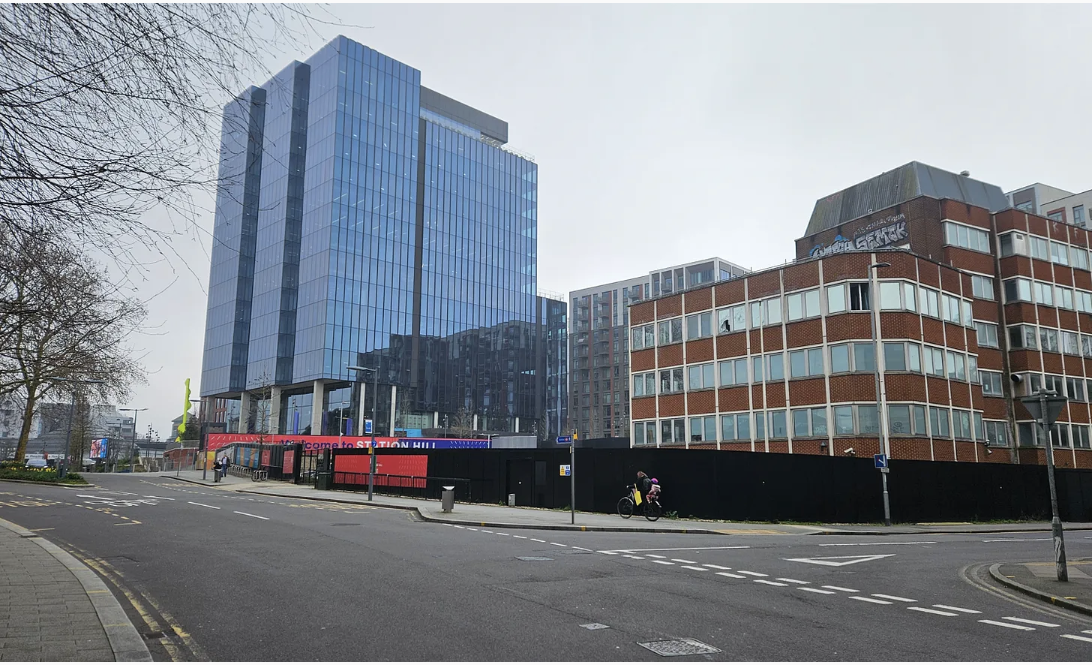
ONE Station Hill rises above the dilapidated Xafinity House at the crossroads with Greyfriars Road, where there are plans for future development and the completion of the huge regeneration project. Picture: The Reading Reporter

It condemns some businesses to closure, says Brownfoot, because areas long consigned to redevelopment suffer a devastating loss of footfall. “Breaking eggs to make an omelette,” she calls it.

Brownfoot reserves her strongest condemnation not for Mr Garvey (they are long-time acquaintances) but for local councillors who, she claims, hold up development in Reading to score political points.

Councillors defend their right to scrutinise planning applications in detail as a necessary system of checks and balances against potentially greedy developers – and a way of fighting for local residents’ needs, including housing provision and improvements to the public realm.

The result, says Brownfoot, is years of waste: of those businesses that have gone bust, of those areas left dilapidated, of effort and work by developers and council officers to reach agreement on what constitutes an acceptable and viable planning proposal that remains profitable – but most importantly of time.

Under the current system, major developments can take years to move from conception to planning consent — long enough for wars, inflation and energy shocks to upend the global economy.

Last week John Lewis scrapped plans to redevelop its former Reading collections centre into flats, blaming a “fundamental shift in economic conditions”.

Brownfoot says it is “inevitable” that more of Reading’s major redevelopments will also never go ahead.

“After years of waiting for consent, you have to do the figures again in order to get funding. That’s where it starts to unravel. Once you factor in things like social housing contributions, I wouldn’t mind betting an awful lot of these schemes don’t work, just become commercially unviable.

“It’s a major concern. We’ve broken the eggs to make the omelette, but now we can’t make the omelette. So now what are we going to do?”

The answer, she suggests, could be to refurbish old buildings rather than completely rebuild. “You almost go back to where you started, just work with what you’ve got. Make it as good as you can, and get it let.”

But if that presents a gloomy prospect for Reading, the market offers a robust defence against Mr Garvey’s charges.

Take‑up of commercial space in Reading in 2025 was 52% above the five‑year average, according to a report by Savills’ research team, which credits “requirements for out-of-town, single-let buildings with high-security specifications from defence and manufacturing occupiers”.

The headline move was the Global Combat Air Programme’s decision to locate its headquarters in Green Park. A multi-national effort between the UK, Italy and Japan to develop the next generation stealth fighter jet, GCAP’s move to Reading is reportedly set to bring thousands of high-skilled jobs to the area. The leasing of 155,500 square feet across 450 South Oak Way and 350 Brook Drive marked the first deal over 100,000 square feet since 2023 in Greater London and the South East. It more than makes up for VodafoneThree’s departure for Newbury.

A cluster of cutting-edge defence businesses is developing in Reading. The government’s commitment to significant increases in defence spending looks set to support the town’s office market and wider economy.

The Atomic Weapons Establishment is located nearby in Aldermaston and Burghfield, and last year it also signed a lease for all of 250 Brook Drive in Green Park. AWE is responsible for the development of warheads for the UK’s nuclear weapons.

Heading east out of town, Microsoft has consolidated its UK headquarters into 80,000 square feet at the Here building on Thames Valley Park. Oracle is searching for a new HQ, either out of town or in the town centre – but it remains committed to Reading.

Savills’ report highlights the continuing trend of the “flight to quality”: corporate occupiers relocating from out-of-town locations into prime or refurbished Grade A buildings in well-positioned town centre locations. This is expected to continue, and drive further rental growth across the region – especially in Reading’s prime asset.

One Station Hill, hailed for bringing to Reading “super prime” office space – the highest available anywhere – is now 70% occupied. Demand for the remaining space outstrips supply, say its owners. “Blue-chip corporates” are in negotiations with Lincoln Property Company’s agents for the remaining space, bringing the prospect of more high-skilled, high-earning jobs to the town.

One Station Hill is being filled from the bottom up, and it will require “record-breaking” rents to lease the top floor alone, says Tom Fletcher, a local market specialist at Hatch Real Estate, and the key local agent for Lincoln at One Station Hill.

Records have already been broken. The first let at One Station Hill was the first time £46 per square foot had been reached in Reading. It has now let space at £56 per square foot. The record price per square foot in Greater London and the South East is £64.50 at the Explore office in Richmond, according to Savills. That bar will be raised in Reading, suggests Fletcher.

But the local market is far more than One Station Hill, he says. Reading remains “the darling of the Thames Valley”.

“It’s certainly not lost its competitive edge,” says Fletcher. “The connectivity – road and rail transport – is better than ever. It maintains the vast majority of its corporate occupiers. Some have been lost, retrenched back to their HQ locations. But actually we’ve gained many more.”

Fletcher cites as examples the recent arrivals in Reading of GCAP, Centrica, Adobe and Wireless Logic. Kenvue, the retail arm of Johnson & Johnson, has – look away now, Mr Garvey – left High Wycombe for Reading.

The Global Combat Air Programme – a multi-national project to develop a next-generation stealth jet – has headquartered in Reading’s Green Park. Picture: GCAP

PWC and PepsiCo are among the tenants paying top dollar at One Station Hill – but that does not make the rest of Reading’s office stock obsolete, nor mean that Reading has lost its cost advantage, argues Fletcher. The opposite, in fact, because not every company can afford prime rents or would want to pay them, yet there remains a space for them in the Reading market.

“Everything evolves – and Reading is having an evolution, one of many that it’s had or will have in the future,” says Fletcher.

“There are still office buildings in Reading, whether they’re Grade A or B, that are as competitive as they used to be, if not more competitive than other properties in the wider Thames Valley market. A building like Reading Bridge House, which is a 1960s tower that has had numerous refurbishments, serves a purpose. It meets a market requirement and it has success every year.”

Some buildings have naturally reached the end of their shelf life as an office building though. “Well over 600,000 square feet” of Grade B and Grade C office space is being converted into residential apartments, says Fletcher – “and that’s no bad thing, it’s part of the evolution”.

He uses Abbey Gardens as an example of a dated building that failed to keep up with the times yet is now finding a new purpose. By contrast Davidson House, on Forbury Square, is now investing in its environmental credentials and coming back to the market with space with an Energy Performance Certificate (EPC) rating of A – the highest possible. That offers a 23-year-old building the potential for a new lease of life, in every sense.

Yet some buildings are no longer for this world. “There is always going to be some obsolete or potentially obsolete stock in the market,” says Fletcher. “But there’s not many buildings in Reading that are properly obsolete.”

One that is, as Mr Garvey suggests, fit only for demolition ironically forms a key part of Reading’s future success.

Xafinity House sits empty, graffiti-ridden and broken-windowed on Greyfriars Road, the last legacy building within the Station Hill redevelopment site. It is obsolete in every sense of the word, yet the wrecking ball will not arrive until the next phase of the project has received planning consent and funding. So, possibly not for several years. The proposals are currently out for consultation in preparation for a planning application.

Fiona Brownfoot has a warning.

“What’s built at Station Hill,” she says, “is fantastic, game-changing, award-winning – but it’s still relatively small scale. It’s one office block and two residential blocks. It still needs to be more, because what’s sitting next to it is a car park and a horrible, vandalised building – Xafinity House – which doesn’t give a good impression of Reading.”

Phase 3a of the Station Hill project will see Xafinity House demolished and replaced by one of two new residential blocks, together housing 600 apartments – another potential cornerstone in meeting demand for residential housing. Phase 3b will then add another office tower – TWO Station Hill – at a later date. If, of course, all of this is approved and funded. That is vital for Reading, says Brownfoot.

“It is really important that this firmly cements Station Hill as a new destination within the town,” she says.

It is hard not to question the commercial viability of such projects in the current climate. The US is at war in the Middle East with no clearly defined goals, and the price of oil and gas is spiking again. Energy and construction costs have never fully recovered since the start of the war in Ukraine in 2021. These are not just problems for the regions affected – chill winds blow across the global economy, all the way to Reading and far beyond.

Yet there remain many reasons to feel optimistic that Station Hill will reach completion. Its owners, Lincoln, had the vision and audacity to drive through such an ambitious project when previous owners had failed. Lincoln has a demonstrable record of delivering such projects at scale amid cost pressures across the globe, and its ambitions for Station Hill still burn bright, says the man in charge on the ground in Reading, Lee Fearnhead.

“The timeline we shared to have phase 3a completed by 2030-31 – that’s achievable,” he says.

Fearnhead should know – he’s been driving this project for nearly a decade now. He’s also not fazed by the cost pressures and construction complexities thrown up in times of global hostility and macro-economic turmoil.

As the Director of Construction for the UK and Europe at Lincoln, he worked on another major building at the same time as ONE Station Hill, in Poland. Just as they broke ground, war in Ukraine began. They were forced to reappraise all their labour and materials, much of which came from Ukraine, Belarus and Russia. The end result was, he says, “the quickest-leased building in Polish history”.

Fearnhead even has positive things to say about Reading Council and their facilitation of Station Hill. “I’ve had nothing but support from the council,” he says. “I was actually quite surprised!”

There are many hurdles to overcome, but Fearnhead believes that Station Hill is helping Reading to build a new reputation, and adjust to the new post-pandemic economy, where workers will spend increasingly more time back in high-quality office space. Its art and architecture, especially the lit-up, moving, cartoon mural by Kev Munday and Stu Melrose, make it an outstanding destination.

“You need these statement buildings to come forward, because they will take the bigger players in the market,” he says.

“We are all confident on our side of the table, that if TWO Station Hill gets the go-ahead then we will smash it again. We were always taught, if you go with the right attitude, the buildings will be successful.”

Fearnhead’s bosses are not content with one award-winning office building. They want another, right next door.

Brash American property developers are not popular – mainly due to one man. You know who.

But one American developer has changed Reading forever – and it intends to deliver again.

The Global Combat Air Programme – a multi-national project to develop a next-generation stealth jet – has headquartered in Reading’s Green Park.

The Global Combat Air Programme – a multi-national project to develop a next-generation stealth jet – has headquartered in Reading’s Green Park. Picture: GCAP

Previous
Previous

The plan to bring beavers, eagles and crystal-clear rivers to Reading

Next
Next

Why your council tax is rising (again)