
A night with Sanctuary Strikers – the football team helping refugees rebuild their lives
Meet the extraordinary man forging community, hope and opportunity through sport
Today we train with Sanctuary Strikers, a football team helping to integrate refugees in Reading, and meet their inspirational manager, Tomson Chauke.
The Reading Reporter delivers original, ambitious and independent journalism for our town. If you value local reporting like this, please subscribe – and share this story with family and friends.
“No one wants to live in a foreign land. You want to be where you were born. You want to be connected to people that you grew up with, the people that know you.”
So says Tomson Chauke, the co-manager of Sanctuary Strikers, a football team founded to help refugees integrate with the community in Reading.
On a bitter midwinter evening like this, it’s hard to see who would want to live in a place so cold and dark. The wind bites. From the sky to the soil everything is grey and brown.
Yet slowly they arrive. Tomson is first. He’s a big, broad, force of nature with a smile to match. Tomson grew up over 5,000 miles away on a sugar estate in southern Zimbabwe, in a place called Hippo Valley. The wildlife here in Prospect Park amounts to a few squirrels and ducks. While he sets up a series of portable floodlights to illuminate tonight’s training session, others join us.
Not many, mind. It’s Sanctuary Strikers’ first session after a Christmas break, and the bad weather has put off many of the team from playing tonight. Tomson is trying to cajole more players into action, fielding calls and Whatsapps, shouting at figures across the park to hurry up, juggling people. Eventually he decides it’s time to get on with it.
“Come on! We’ve all got Christmas turkey bellies!” bellows Tomson, and we’re off. He leads the hardcore of Sanctuary Strikers into a jog and then a series of stretches and sprints. There’s Ramsey, a tall, graceful athlete from Sudan, and Balde, a lean and slight man from Guinea-Bissau, plus Tomson’s teenage son – and The Reading Reporter too. Next week’s attendance will be better, thankfully.
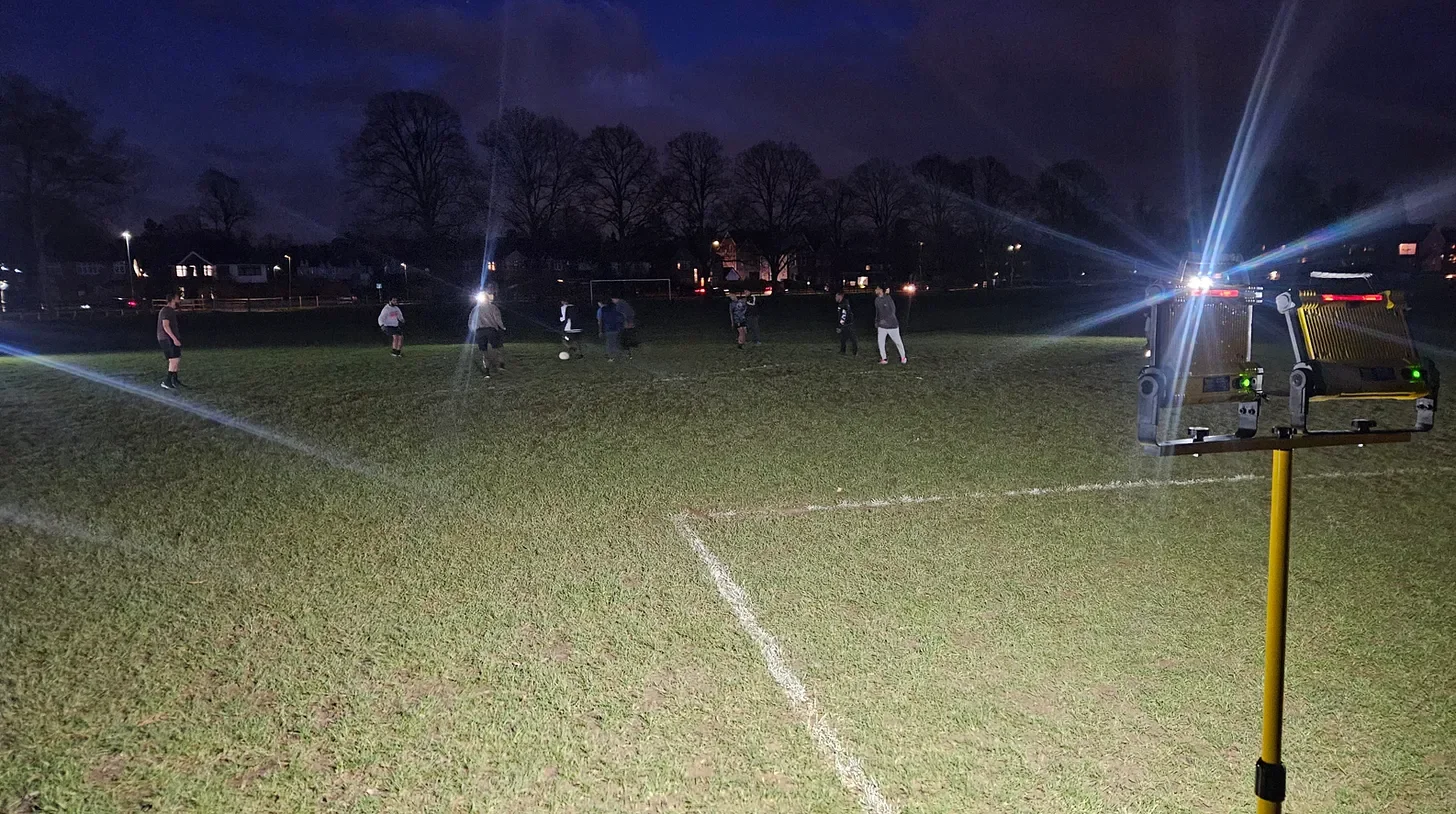
Some of the Sanctuary Strikers football team in training at Prospect Park. The team was set up to help refugees integrate. Picture: The Reading Reporter
But tonight there’s another new recruit – a young asylum seeker who’s turned up for the first time. He’s only recently arrived from north Africa, and through broken English tells Tomson that he has no clothes for football other than what he’s wearing. Which isn’t ideal, because he’s soon slipping and sliding around, his trainers near useless in the wet mud.
No matter though, because Tomson will sort him out with a pair of boots for next time; and sporting excellence isn’t the primary aim of Sanctuary Strikers anyway. Simply being here, among his new team-mates, is a success in itself.
Ramsey is the leader among these players, and he takes charge of some athletic warm-ups and skills challenges. Ramsey claps us through each drill, adding rhythm and pace, and encourages us to feel warmth spread through our muscles while we stretch. It is a mindful moment amid the evening gloom.
Balde, by contrast, is a whirl of energy, earning praise from Ramsey – not sergeant-major barks but quieter, more respectful encouragement – signs of a different football culture.
Talk of the Premier League does, however, light up their faces. Balde, a left back, idolises Bernardo Silva. Like Manchester City’s Portuguese playmaker, Balde comes across as humble, quiet and polite.
Ramsey has lived in Reading for the last nine months, and has his sights set on following his hero Bukayo Saka into professional football. “I need a new team… I need to play in the Championship at least,” he smiles.
It might be cold and dark, but living in the home of the Premier League allows them to dream. It is a foreign land but it offers them the chance to escape the troubles of their past. Memories that make their eyes lower towards the ground, and their voices quieten when you mention home.
* * *“I’m driven by helping someone,” says Tomson in his soft, soothing way. “That’s what drives me, because I’ve been helped. I know it’s important to help someone in need, because I also needed help. We all need support.”
Tomson knows how his players feel when they turn up for the first time at Sanctuary Strikers. He was once a refugee too.
Back in Hippo Valley, he was no footballer – he was a musician. A kid who caught a break when a touring band’s drummer fell ill and he filled in at short notice, then never looked back.
But the political winds changed in the late 1990s under Robert Mugabe’s rule, and as Zimbabwe suffered economic strife it became more conservative and hostile towards Western or liberal influences, such as musicians – people like Tomson. His record label shut down and people had no money to attend gigs, so life became unbearable.
“I love Zimbabwe. It’s the country I was born in. Everything that I have is from there. But when you find yourself scavenging for money, for food, to look after your family, it’s tough.”
The final straw came when Tomson and his band – one of the most popular in Zimbabwe – were pressured to play at political rallies. “I was thinking: do I want to do this? This is not my thing. As a musician, you just want to be neutral.” But if he refused to play, he would be in danger. Mugabe’s government used violence and intimidation, deploying police and military forces against political opponents and critics.
So Tomson chose to leave his beloved homeland for the sake of his family, and came to the country he had once toured as a musician.
He was now safe – but he was alone in a strange land.
“The first year was a nightmare. I was even thinking of going back. I wanted friends.”
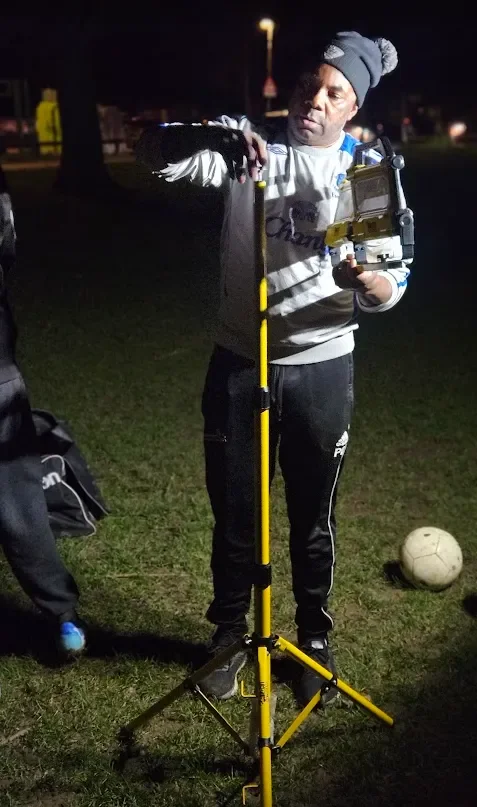
The team’s co-manager, Tomson Chauke, sets up a floodlight to help the players train on a dark evening. Picture: The Reading Reporter
Tomson found a welcome as cold as the weather.
“English people don’t welcome you that much at first!” he laughs. “What I’ve learned is that in English people’s culture, they don’t speak to strangers unless you’ve got something for them. They’re really nice people to the community they know and the communities they want to support. If they know you: oh, you’re in a good place.”
But that didn’t help in the early days. Tomson lived in – and left – Bristol, Bolton and Luton, searching for friends. So he decided to try the place he remembered from a gig years ago. It was at a venue called Rivermead.
There he finally found his community.
“I started volunteering for Reading Refugee Support Group, and as soon as I came I met friends.
“I’m a happy man right now, because I’m now connected to a lot of people.”
Tomson must be one of the most connected people in Reading. Alongside Reading Refugee Support Group and Sanctuary Strikers, he also manages after-school clubs, has a show on B Radio, and plays in a band called Limpopo Groove. You might also have met Tomson during one of his World Groove workshops, where he leads groups of children drumming and singing together, encouraging connection and community through music, while wearing his signature African feather headdress.
But Tomson never forgets how it feels to be lost and lonely.
“Most of the stuff that I do revolves around Reading Refugee Support Group. Because when I came here and got support from them, I felt that I needed to also give it back.
“I go out there in the community to raise awareness about refugees, because the climate now in England doesn’t favour refugees.”
But Tomson does not bemoan the rise of Nigel Farage, Reform UK and anti-immigrant rhetoric, as you might expect.
“Some refugees come here and don’t do what’s supposed to be done. I feel like when you are in England, join in, be part of the community. Help build the economy if you can, so that in return you’re living a good life.”
Tomson is happy to give refugees some blunt advice on how to live in England – just as he does while barking instructions to his players on the football pitch.
“Learn English. You’re in England. Come on. You can’t come here and want people to learn your own language. That’s not fair. That’s not right. Don’t take advantage of the situation. You just want to sit at home and make money because you can get benefits? No, that’s not what we came here for.”
Tomson feels parts of the community are much more “hostile” to refugees nowadays – but he doesn’t accuse English people with anti-immigrant feelings of xenophobia or racism. He actually sympathises with them.
“I feel for people who don’t understand refugees. They don’t know what people are going through in their lives. Because some refugees, the minority, come here and don’t do the right things, and they’re the ones (whose stories) shout the most, in the media it comes across that refugees are bad people. So people don’t understand why refugees are here, they just think people are now coming here, they’re taking our homes, they’re taking our… you know.”
Tomson doesn’t have a bad bone in his body. He looks for the good in people. But he does blame the system – the government – for failing refugees.
Asylum seekers are not allowed to work while their claim to stay in the UK is being considered. Those whose applications remain undecided after 12 months may apply for permission to work in certain shortage occupations. Only once refugee status is granted do they have unrestricted access to the labour market. Tomson thinks this is wrong for both the asylum seekers themselves, and the wider community. He wants them to contribute to the economy, to help pay for themselves, to integrate from the moment they arrive here.
“I wish the government could create a situation where you don’t just home people. Give people a chance to work. Find out who the refugees are, what they can do, and put them in the right places. If you just house people and make them sit in a hotel and wait for their paperwork to be sorted, then if I’m English, I wouldn’t be happy with that, because people are working so hard to put food on the table, and paying their taxes. There’s a contribution needed from refugees themselves, the government the most, and then the community. It’s a puzzle together.”
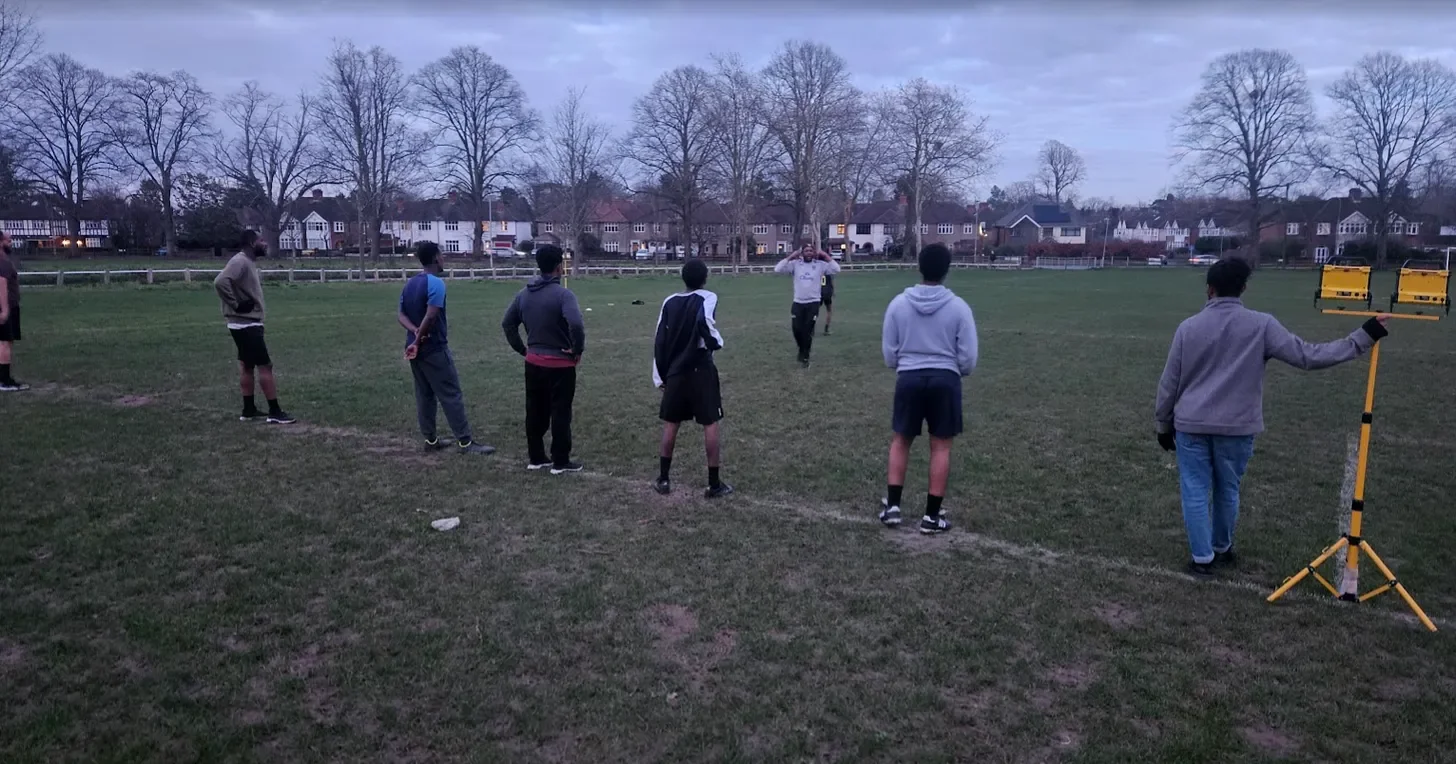
The Sanctuary Strikers players were earlier led through warm-up drills by Tomson. Picture: The Reading Reporter
Tomson is doing his best to help solve it, but admits he is “just a drop in the ocean”.
He says there is council funding available to help local community groups like his, but that most people don’t realise it is available. He would also like to see council officers be more proactive in engaging with the refugee community to help integration.
“I think they spend more time in offices filling in forms than actually going into the community,” he says.
“I would like the council to go straight into the community, bring them round the table, ask people questions. What can you do? What can we do? How can we help each other? What is it that you did in your country? There are talented people from the refugees’ community that don’t know what to do, because all they’re waiting for is their paperwork.”
Showcasing refugees’ talent is another fundamental aim for Sanctuary Strikers – but there are others too. Helping players learn about their new home and the native language, and even how to travel independently around town are others. All help to build confidence, which takes a huge knock when you arrive in a strange new country, says Tomson.
“If you’re in a class, it’s daunting. You feel like you’re back at school, and no one loves school, especially if you’ve grown up. But if there’s an activity that you love to do, then there’s an opportunity for you to learn. When we’re chasing that bag of air – a football – and pushing each other, talking and shouting at each other, then there is context. So players come in, pick up some words, and then use them. They start to make friends. They can learn English in an environment that is supportive and friendly.”
The inspiration came when Tomson’s own son arrived here from Zimbabwe aged 11. Tomson wanted him to integrate and make friends, so he called his own friends and asked them to bring their own children along for a game in Cintra Park. That became a regular Friday kickaround. Tomson, being Tomson, stumbled across sources of funding, including from Grow the Game. Sanctuary Strikers was formed and they joined the local Sunday League. Tomson was drafted in as goalkeeper. “I shipped in a lot of goals that season!”
But the results were not important. The vision was. Tomson and Joel Joseph, himself originally from Tanzania, wanted to blend the local community with refugees to support each other and work hand-in-hand. “We’re getting the community to understand the people that are coming to live with them, so that there’s no stereotyping and neglect. Psychologically, you want people to understand that if we work together there is something good that can come out.”
It worked. The team won promotion and lots of their players were recruited by top-division teams. At one point, seven refugees all went to play in Division One, and some of them played semi-professional football. It hurt Sanctuary Strikers but Tomson didn’t mind – he would never deprive anyone of the opportunity to play for Reading City, Bracknell or Aldermaston. He has now set up a system where semi-professional teams are asked to donate money to fund the development of other Sanctuary Strikers players if they recruit one.
The turnover of players tends to be high anyway. Some leave Reading for work or alternative accommodation after their asylum claims are accepted. Others are rejected and leave. This season was unusual: they had 32 new players.
Tomson’s main challenge is finding new sources of funding to keep the team running. The John Sykes Foundation has helped – providing a whole set of portable, rechargeable floodlights so the team can train without hiring a pitch. Both Sykes and refugee charity Care4Calais have also provided boots for players, who usually arrive with nothing. There isn’t room for football boots on a tiny boat crossing the Channel.
Still Tomson needs to find more support, because it costs thousands of pounds per season to run Sanctuary Strikers – and he often has to spend money from his own pocket. He has not yet found a sponsor for their kit, and is now willing to consider a corporate sponsor to keep the team going. “I’ll knock on people’s doors, I’m not afraid,” he says with defiance.
Tomson feels a sense of duty not to give up.
“There are some hard stories that we come across. It’s part of our job. We just have to make sure we support as much as we can. One boy had nowhere to go. One lost his mind. He was not in a good place.
“Sometimes we have to mentor people. You can call them out for a drink, just to make sure he knows you’re there. Or we will tell him that we will find someone or a solution if we have to.”
Other charities and institutions help too, such as Kit Aid, Reading Football Club’s Community Trust and the University of Reading, which runs an annual football tournament along with Sanctuary Strikers to raise awareness.
There is now no general legal route into the UK for people seeking to claim asylum, aside from a select few schemes, including for Ukrainians and Hong Kongers. That means most refugees have no lawful way to arrive here, leaving many with no other option but to board small boats in the hope of reaching the UK to claim asylum.
“Sudan is one of the countries that needs a lot of support, because that country’s war is not ending,” says Tomson. “There’s focus and a lot of money poured into (helping) Ukrainians, but we’ve always had people coming from Sudan. I have never seen major support. There’s a little support here and there, like a case worker, but that’s where it ends.”
Tomson will never turn away a player. They are referred to Sanctuary Strikers from other agencies, or the local community. He gives his own time and money to help anyone who needs it, whether they are a refugee or simply struggling with life. “We’re here,” is his simple message.
* * *“We’re going to sleep like babies tonight!” yells Tomson, encouraging his exhausted players through their final training drills at Prospect Park.
I think I’ll sleep in some pain, actually. I went shoulder-to-shoulder with Tomson, challenging for the ball during our small-sided game, and was sent flying, wrenching my lower back.
Standing on the sidelines, behind one of the portable floodlights, a teenage player watches the action.
He’s injured so can’t join in, but he’s in good spirits. He is one of the team’s top goalscorers this season, and has played for a semi-pro club already. Lean and wiry, he’s trying to emulate his idol, Lionel Messi.
He’s happy to show off some personal highlights reels on his phone – a free-kick into the top corner, a dashing run in from the left wing then a terrific finish. Like everyone else, he dreams of becoming a pro, and wants to play for Chelsea.
Stamford Bridge is a long way from the dry and dusty mud he learned to play on in Africa. He smiles at the wet grass under our boots – there was never grass to play on back home. But football in England is very hard, he says. It is physical but also very technical, whereas in Africa it is more aggressive.
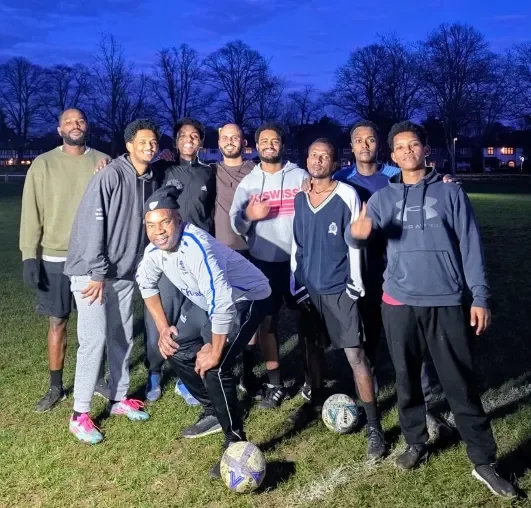
Tomson and his players come together after training. Picture: Sanctuary Strikers.
He’s glad to be in the UK because there is freedom here, he says – unlike back home, where young people his age are forced into military service. They are beaten or arrested if they refuse, and he knows many people have died during military service.
His family have nearly all left for other countries. He misses them, especially his mother.
He shouts over at a player who has collapsed in a heap after a long, lung-busting run up the pitch. It’s a few short bursts of Tigrinya, but most people here probably understand – laughing at your team-mates is the universal language of football.
It’s chaos out there. Tomson has forgotten the bibs so, even with all the floodlights on, the pitch is a mass of bodies, a disorganised mish-mash of colours. No one cares.
They have crossed continents and risked everything to be here, now, playing football in our local park.
But it’s too cold, even for Tomson. He calls an early end to training so everyone can warm up and watch the Champions League on TV. Even he has his limits.
Balde and the new recruit from north Africa are talking. They smile, point towards the distance and walk off together into the night.