Spring flowers, sex scandals and missing penises – just another afternoon in Reading

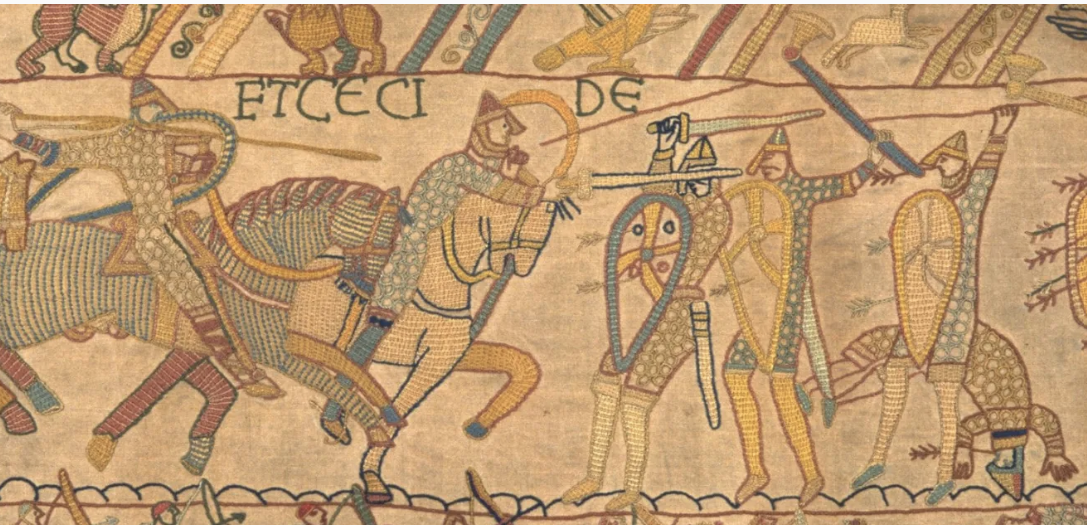
A section of Britain’s Bayeux Tapestry, which is housed in Reading Museum. It is a replica of the world-famous medieval artwork, which tells the story of the Norman conquest of Britain and the Battle of Hastings in 1066.

Why one of the world’s most famous medieval artworks has a twin here

With the world talking about the Bayeux Tapestry again, I finally stopped ignoring Reading’s replica and discovered why this remarkable 70-metre medieval epic has found a rightful home here.

Aargh! What was that fiery ball blinding our eyes? What about that strange prickle on the skin? Ah yes – that’s the sun, and warmth. And what better way to welcome the arrival of spring, its clouds of blossom and flowering magnolias, than to head inside the dim, cosy rooms of Reading Museum and take in the Bayeux Tapestry replica?

Not convinced? Well, someone’s definitely been spreading muck on the fields somewhere west of Reading, so if you need somewhere to take refuge from the aroma drifting over parts of the town then maybe that’s a reason to visit.

Plenty of people are visiting. The impending loan of the original Bayeux Tapestry by France to Britain is exciting the worlds of art and history, and the buzz is spreading to Reading.

It was probably made in England over 900 years ago. At 70 metres long (and 50cm tall), the tapestry tells the story of the Norman conquest of England. Stitch by stitch and in vivid colour, the legends of William the Conqueror and King Harold Godwinson – yep, the one who got an arrow in his eye – are woven before us. It is world-famous medieval art and artefact, and Reading, remarkably, has its own full-size replica.

Every last detail of the original was painstakingly copied by a team of 35 Victorian embroiderers so that the people of Britain could enjoy the story too. Well, not every detail – there are 93 or 94 missing penises. That’s a legitimate academic debate, you know. But the Guardian calls Reading’s replica a “prudish triumph”!

Truth be told though: the tapestry replica has never interested me. Like every former child in Reading, I was forced to visit on a primary school trip. Nothing from that visit sticks in my memory, except a vague memory of boredom. I’m pretty sure the thing about the missing penises wasn’t mentioned back in the 90s. I’d surely have remembered that.

Behind Reading Museum sits the Abbey ruins, which link the Bayeux Tapestry to the town we live in today. Picture: The Reading Reporter

The tapestry trip ranked well below the undisputed champion of all school outings: the newly opened Tesco on Napier Road, where we pumped strawberry jam into doughnuts and ate our homework before the dog got the chance.

Two childish thoughts prevented me from going back to see the tapestry: who wants to see a replica, and why’s it even in Reading?

But that’s not unusual. London’s museums are full of visitors who don’t live there. When something sits on your doorstep it becomes strangely invisible, even world-class art.

With the world’s eyes back on Bayeux, however, I finally went to see it again, 30-plus years later.

Adult eyes help you appreciate just what an extraordinary effort it was to recreate the entirety of this enormous artwork with such meticulous accuracy. It sprawls across wall after wall, winding around two rooms. In 1885, Elizabeth Wardle, from Leek in Staffordshire, led her team to begin work, and by 1886 it was complete and on display, then taken on tour.

Many people around the world believe they have seen the Bayeux Tapestry at an exhibition in their home city – but the French remain stubborn about moving the original, concerned about the fragility of the fraying threads, so it is Reading’s replica that these people have unwittingly seen.

The excellent guide, Chiara, explained how the slow build-up to war contains courtroom intrigue, international plotting and deadly treachery.

There are scenes of sex scandals, domestic violence and rescues from quicksand. Wild and mythical creatures frame the action, their own dramas running parallel to the human story, providing moral warnings like the Greeks used their gods or Aesop his fables. Halley’s comet even makes an appearance. Having a guide to explain why brings everything to life.

Without Chiara’s expertise, some could be snooty about the quality of the imagery. This is one-thousand-year-old storytelling, and it looks like it. But, with characters like Edward the Confessor and Bishop Odo plotting and scheming in the background, this multi-layered story is more like Game of Thrones than you’d think at first glance.

The tapestry explodes into vibrant colour when William the Conqueror’s armada heads for England, with ships and sails decorated in blue, red, gold and more. The Battle of Hastings is full of death and horror, severed heads and speared bodies – and Harold’s eye, of course. But there’s controversy behind that too, which is worth hearing for yourself. As are the reasons for those infamous missing penises.

Arthur Hill, a former Mayor of Reading, bought the replica when the Leek embroiderers became fed up of touring and cashed in. Their names are stitched into the borders, marking who created each panel. It was first exhibited here in 1897 and, after touring, found its home in 1993.

Behind Reading Museum are the ruins of Reading Abbey, and walking around the crumbling stones afterwards, it all began to make sense. The Abbey was founded by Henry I, who seized the English throne in 1100 after a power struggle with his elder brothers. They were all sons of William the Conqueror, whose own ascension to power is told right next door.

William’s connections with Reading are enduring. The Battle ward to the west of the town centre, including much of the Oxford Road and its side streets, takes its name directly from the Battle of Hastings. William gave this land in Reading to Battle Abbey in Sussex, which was founded on the site of the famous battle in 1066.

After seeing the site of Henry’s burial, I wandered out of the Abbey and through the gate into Forbury Gardens, to be greeted by a rainbow of crocuses and daffodils.

Turns out you can enjoy spring and the Bayeux Tapestry on the same afternoon in Reading.

Reading Museum is FREE to visit (Tues-Sat). Britain’s Bayeux Tapestry guided tours (Tues 2.30pm, Sat 2pm) cost £8.

Previous
Previous

“You’re rubbish, but you work hard!”